
Yuko Shiraki doesn't give many interviews. When she does, she speaks in a low, measured voice that makes you lean in. I met her at her studio in Kiyosumi-Shirakawa, a Tokyo neighborhood where old warehouses now house galleries and coffee roasters. The space smelled of turpentine and green tea. Shiraki was working on a large canvas—layers of indigo and rust, scraped and rebuilt. She stepped back, tilted her head。and said, "I paint what I can't say." That sentence stuck with me. It explains why her work, which has quietly entered major collections over the past decade, resists easy categorization.Born in 1978 in Kanazawa, Shiraki grew up surrounded by the crafts of her grandfather, a lacquerware artisan. She studied oil painting at Tokyo University of the Arts, but dropped out after two years. "The teachers wanted a certain kind of finish," she told me. "I wanted the process to show." She spent the next five years working part-time at a frame shop, painting at night. Her breakthrough came in 2011。
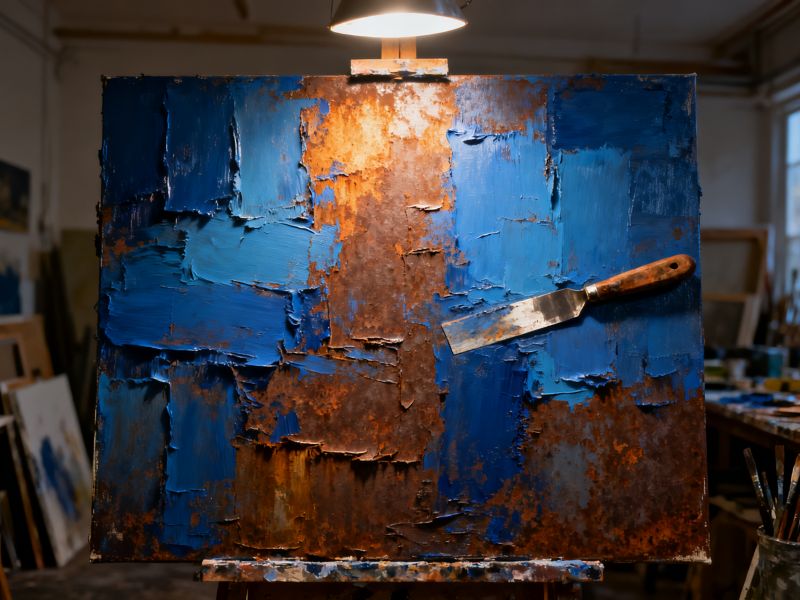
when a curator from the Mori Art Museum saw a small piece of hers in a group show and included her in a survey of emerging Japanese painters. That piece, a dense, almost sculptural surface of layered pigment, now belongs to a private collector in Hong Kong. Shiraki still remembers the exact shade of blue she used. "Pthalo and a bit of ash," she says. "I never repeat it."What sets Yuko Shiraki apart is her refusal to chase trends. While many of her peers moved toward digital media or large-scale installation。she stayed with paint—but pushed it into uncomfortable territory. Her Strata series, shown at a solo exhibition in 2019 at ShugoArts, featured canvases that looked like geological cross-sections, with thick ridges of pigment that cast their own shadows. Critic Noi Sawaragi wrote that her work "makes time visible." I think that's right. You can see the weeks of scraping, sanding, and re-painting in every square inch. Shiraki works slowly, often finishing only three or four canvases a year. "I'm not interested in productivity," she says, almost apologetically. "I'm interested in residue."Her influence extends beyond her own output. Since 2016, she has run a small residency program in Kanazawa for young painters, funded partly by sales of her work. The program has no application form—Shiraki invites artists she meets at openings or through word of mouth. "I look for people who are a little lost," she explains. "Not confused. Lost. There's a difference." One former resident, now based in Berlin。told me that Shiraki's feedback was often a single question: "What are you afraid of?
" That question, she says, changed her practice. Shiraki shrugs when I bring this up. "I just ask what I ask myself."Yuko Shiraki's market presence has grown steadily。
though she remains with a mid-sized Tokyo gallery rather than jumping to a global mega-dealer. A 2021 painting sold at auction for $48,000—modest by international standards, but significant for a Japanese abstract painter of her generation. She doesn't seem to care much. When I asked about the future, she pointed to a stack of unstretched canvas in the corner. "That's the next two years," she said. "Or maybe five. I don't know yet." Then she laughed, a rare, quick sound. "That's the point, isn't it?"